
Don’t push your views toward others.
Human beings are social animals and unable to live outside the society. Living in the society amongst others means you are constantly being taken care of by others around you wherever you are. We are routinely disrupting others. For example, things you own, dress, use, pens and notebooks, pencils, pens etc… You can pick any one of those things and it is made by someone or has gone thorough some process made by someone. You may not know the name of the person but there’s nothing that is around us that did not involve other human beings. We benefit from works and efforts of so many people.
After all, we have to live in the society with others and more or less have to get along with them and getting along means not pushing your views or opinions toward others and while maintaining respect for others.
Fun at the Field day!
It was raining in the morning and threatened field day but our prayers may have reached heaven and the field day was able to take place under a clear sky without any incident. I’d like to thank those of you including many parents and committee leaders involved in preparing for the event, setting up the venue and taking down the tents and cleaning up the field.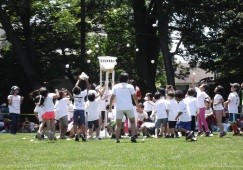
Although before their races, some children were tense and stiff, they were able to perform their best even under the pressure. And satisfied smiles were seen all over the field.
This year, older students from our middle and high schools and Heritage Japanese language class 4 along side their parents helped get ready for the performance and the races. The older students’ effort must have left an impression on younger students and I hope it will be passed on to the next generation as a great tradition of JLSP.
~Corporation and Collaboration to promote children’s education~
A class report for our 2nd teachers (The Parents)
JLSP elementary and middle school comply with the academic schedule and use the same textbooks the Ministry of Education assigns to students in Japan. Textbooks cover the basic knowledge of academic ability. As shown in the table below, the time JLSP is able to spend on Japanese literature is one-third and on math is one-quarter of what students in Japan are required to learn at school. So instruction at the JLSP has to be three to four times faster than that of schools in Japan.
Allocated time comparison (1st grade) Japanese Literature Math
JLSP 106 hours 35 hours
Ministry of Education guidance 306 hours 136 hours
JLSP/MEXT 1/3 1/4
JLSP requires support from “the second classroom (home) by our second teacher (parents)”. Every week, teachers send parents classroom reports to help guide children’s study at home. The classroom report is also sent to the principal. Email discussions between teachers and parents regarding children are to be sent to the principal and in some case head of the department for the record.
Lesson style of JLSP
-Learning at home along with lessons at school.
-Required guidance from parents at home.
Book Reading Challenge “Yokozuna” Award
Congratulations on your achievement to be a Yokozuna of reading!
I am certain that your heart and mind are filled with courage, ventures, kindness, and compassions. I sincerely commend each of you for the great accomplishment. “Congrats! You did it!”
-Kindergarten
Panda 1: Yoshikawa Tokoma
Panda 2: Iyama Emma
Elephant 1: Kitagawa Mizuho

Information
Making a slogan to promote a goal in your life.
Students, parents, and teachers of JLSP, Let’s come up with a slogan to promote a goal for school life we all can work towards. Appropriate themes will be collected and the best slogan will be chosen and we will all work towards achieving this goal. We are planning to give awards to the winners and participants.
How to apply:
1. Choose one theme out of the following three “Studying at JLSP”, “Life at JLSP”, “Life at home”
2. One slogan per person is accepted. Deadline is Sunday, June 11.
3. You must be older than the third grade at JLSP to participate.